
Aggressive nests don’t wait, and neither do we. Get expert, professional removal of wasps, hornets, and yellow jackets from your Richmond home or business today—safely and permanently.
Bee & Wasp Control in Richmond, VA
A wasp nest on your property is not a problem you want to handle on your own. When wasps feel their nest is threatened, they release an alarm pheromone that signals the entire colony to defend. What starts as one sting can turn into dozens in seconds. At Pest Solutions, our licensed technicians handle bee and wasp nest removal safely using the right protective equipment, species-specific treatments, and methods that prevent nests from returning to the same location.
We have been protecting Richmond-area homes and businesses from stinging insects for over 24 years. Every service is backed by our money-back guarantee, and we provide a written service report after every visit. Call 540-264-9591 or request a free inspection.

How Pest Solutions Removes Wasp and Bee Nests in Richmond
Our bee and wasp control process is designed around one principle: treat the right species the right way. A treatment that works for yellow jackets can be ineffective or even dangerous when applied to a carpenter bee infestation, and vice versa. We never use a single-product approach.
Step 1: Species Identification and Full Property Inspection
Our technician inspects your property to identify the species involved and locate all active nesting sites, including hidden nests inside wall voids, under eaves, underground, and in outbuildings. We assess nest size, how accessible the nest is, and whether any structural entry points need to be addressed after treatment. You receive a written service report documenting everything found.
Step 2: Targeted Treatment by Species
The treatment method depends entirely on what we are dealing with:
- Aerial nests (bald-faced hornets, paper wasps): We apply a fast-acting knockdown product directly to the nest before physical removal. This neutralizes defensive workers before they can swarm.
- Ground nests (yellow jackets): We treat the nest entrance with appropriate products to eliminate the colony, then remove the nest material once activity has ceased.
- Cavity and structural nests (yellow jackets, European hornets): We apply dust or liquid treatments into the cavity through the entry point. We do not seal the entry point immediately, as workers need to contact the treatment material as they pass through.
- Carpenter bees: We treat active galleries with dust applications and apply repellent treatments to surrounding wood. We recommend sealing gallery entrances after the active season to prevent the following season's use.
- Honey bees: Whenever possible, we coordinate with local beekeepers for relocation. If removal is necessary, we advise on the best approach based on colony location and size.
Step 3: Nest Removal and Prevention
After treatment, we remove accessible nests to prevent reuse and to eliminate the pheromone signals that attract new colonies to the same location the following season. We also apply residual perimeter treatments to discourage nesting in high-risk areas around your home's eaves, roofline, and deck structure.
Step 4: Service Report and Prevention Guidance
We walk you through specific conditions on your property that are attracting stinging insects, including exposed unpainted wood, accessible soffits, landscape features near the structure, and water or food sources attracting foragers. Our recurring pest control plans include perimeter treatments that help deter stinging insect nesting season after season.
Stinging Insects We Treat in Richmond, VA
Understanding which species you are dealing with is the first step to effective removal. Different species nest in different locations, behave differently when threatened, and require different treatment methods.
Yellow Jackets
Appearance: Black or dark brown with yellow markings; thin, defined waist; 3/8 to 5/8 inch in length.
Yellow jackets are the most aggressive stinging insect in Virginia and the species responsible for the majority of sting-related emergency calls. They typically build nests underground in abandoned rodent burrows, but also nest inside wall voids, beneath deck boards, and inside hollow trees. A single yellow jacket colony can hold several thousand workers by late summer. Unlike honeybees, yellow jackets can sting repeatedly and will pursue perceived threats. Ground-nesting yellow jacket colonies are especially dangerous during lawn mowing or raking, when vibration triggers defensive swarming. Learn more about ground-nesting wasp behavior in Virginia in fall.
Bald-Faced Hornets
Appearance: Large black body with white facial markings; 1/2 to 5/8 inch in length.
Bald-faced hornets build the large, papery, football-shaped aerial nests you often see hanging from tree branches, eaves, and utility lines. These nests are heavily defended. Hornets post sentries that patrol the perimeter, and any perceived threat to the nest triggers a rapid, coordinated swarm response. By late summer, a single nest can hold several hundred workers. Never attempt to knock down a bald-faced hornet nest with a stick or garden hose. Professional removal requires protective equipment and the correct knockdown treatment before the nest is physically taken down.
European Hornets
Appearance: Large brown body with yellow abdominal stripes and a pale face; 3/4 to 1 1/2 inches in length.
European hornets are the only true hornet species in the United States and the largest social wasp in Virginia. Unlike most stinging insects, they are active at night, which surprises homeowners who find a large, buzzing insect indoors after dark. They prefer to nest inside hollow trees, wall voids, and attic spaces. European hornets are also known to chew tree bark to feed on sap, which can damage ornamental trees and shrubs on your property. If you are finding large brown wasps coming and going from your roofline or siding, European hornets are a strong possibility.
Paper Wasps
Appearance: Brown with yellow or reddish markings; slender with a narrow waist; 3/4 to 1 inch in length.
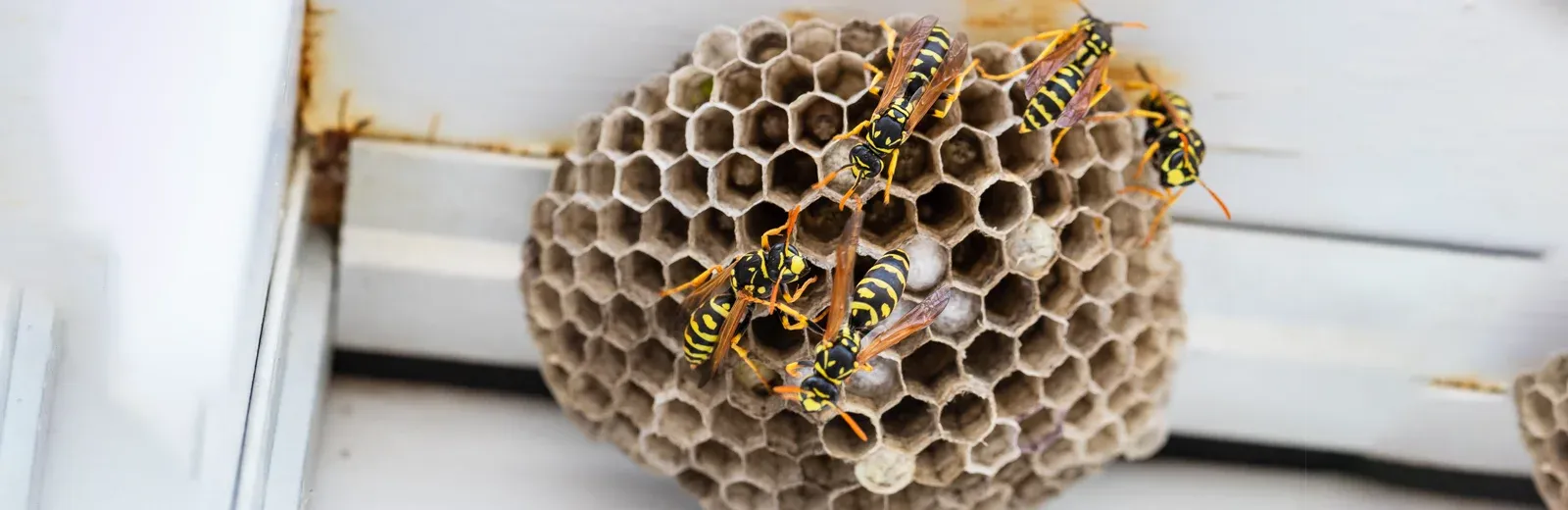
Paper wasps build the small, open-celled umbrella-shaped nests you typically find under eaves, porch ceilings, door frames, and deck railings. They are less aggressive than yellow jackets but will sting if the nest is approached or disturbed. Paper wasp nests are common on Richmond homes because of the abundance of sheltered overhangs. A 6-month warranty applies to external paper wasp nest treatments.
Carpenter Bees
Appearance: Large, resembling bumblebees; shiny, hairless black abdomen; 1/4 to 1 inch in length.
Carpenter bees are wood-boring insects that drill perfectly round, half-inch holes into unpainted or weathered wood to build nesting galleries. In Richmond, the most common targets are fascia boards behind gutters, deck railings, wooden privacy fences, porch ceilings, and window trim. Left untreated, carpenter bees return to the same locations year after year and expand their galleries, weakening the wood structure over time. Male carpenter bees hover aggressively near nest sites but do not have stingers. Females do have stingers and will use them if handled. Treatment involves applying appropriate dust or liquid products directly into the gallery, then sealing the entry hole after the season ends to prevent reuse.
Honey Bees
Appearance: Golden-yellow with light brown or black bands; oval shape; approximately 1/2 inch in length.
Honey bees are protected pollinators and, whenever possible, we prefer to refer swarms and established colonies to a licensed local beekeeper for safe relocation rather than extermination. If you have a honey bee swarm resting temporarily on your property, the colony is typically moving between nesting sites and may relocate on its own within 24 to 48 hours. Established colonies inside wall voids or structural cavities require professional assessment to determine whether relocation or removal is the appropriate approach. We will advise you on the best course of action during a free inspection.
Stinging Insect Control Near Richmond, VA
Pest Solutions is based in Richmond, VA, and services the surrounding counties for stinging insect control. Check if we cover your area:


